

Introduction: Why HDPE Is a Machinable Engineering Plastic
HDPE (High-Density Polyethylene) is one of those “quiet” materials that shows up everywhere: water infrastructure, chemical handling, marine hardware, and tough consumer goods. The reason is simple: it has a strong strength-to-weight balance, very good chemical resistance, and very low moisture absorption—so it stays stable in wet or corrosive environments. That combination makes HDPE a very practical candidate for CNC machining from sheet/rod/tube stock.
From the industry side, HDPE demand stays large because “rigid polyolefins” are still a core packaging + industrial material flow. In Europe, Plastics Recyclers Europe (PRE) reports that in 2023, 13.3 million tonnes of HDPE and PP rigids were placed on the EU27+3 market, and about 2.7 million tonnes were sorted as recycler input (their executive summary gives the same scale and context).(Source: Plastics Recyclers Europe (2024) – European HDPE/PP rigid market 2023 data)
On the infrastructure side, MarketsandMarkets states the global HDPE pipes market was USD 21.82B (2024) and projected USD 28.46B (2029).
So where does machining fit? For custom parts, low to medium volumes, and tight delivery schedules, machining HDPE stock is often the most predictable option. Injection molding wins at high volume—but tooling cost and lead time can be heavy (often thousands to tens of thousands USD, sometimes more, depending on complexity).
Machining gives you fast iteration, fewer unknowns, and good mechanical performance because you’re working from fully solid stock.
Brief History & Context (HDPE vs LDPE vs UHMW)
HDPE is part of the polyethylene family. LDPE came first (industrial production started in the 1930s under high-pressure processes).
Linear HDPE is generally traced to early 1950s catalyst breakthroughs; sources note Karl Ziegler (with Erhard Holzkamp) produced linear HDPE in 1953.
UHMWPE sits on the “very long chain” end of the family: tougher wear performance, harder to machine cleanly, and usually chosen when abrasion dominates.
Positioning (practical view):
-
LDPE: softer, more flexible → not ideal for precision machined parts
-
HDPE: “engineering plastic sweet spot” → machines well with correct chip control
-
UHMWPE: very high wear resistance → machines, but fuzz/stringing is more common
If you want help quoting or optimizing an HDPE part for machining, we do this work at Astrocnc.com (plastics-specific CNC planning, not “metal mindset”).

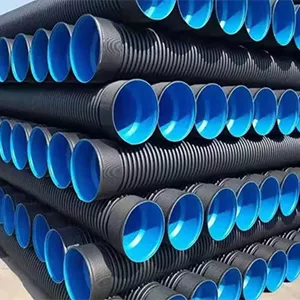
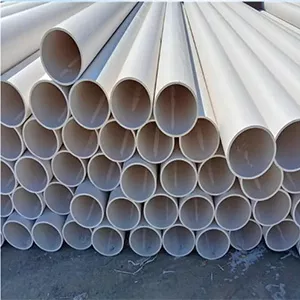
Chapter 1: Understanding HDPE Material Properties
Key Mechanical & Thermal Properties (what matters in machining)
HDPE’s machining behavior is dominated by softening from heat, and movement from stress release / thermal expansion. Basic properties vary by grade, but typical published values show:
-
Melting point ~130°C (266°F)
-
Low water absorption (good for wet use; less swelling from humidity than many plastics)
-
Chemical resistance: widely used for corrosive and salt environments (you see it in rollers, tanks, guards, marine parts).
Important machining reality: HDPE expands more than metals and can “walk” in size if you measure hot, clamp too hard, or remove material on one side only.
HDPE Forms for Machining
Common semi-finished formats:
-
Sheet/plate (router-friendly)
-
Rod (lathe-friendly)
-
Tube (bushings, sleeves, spacers)
Industrial suppliers commonly offer black/white (and other colors for signage/branding).
Typical Applications (machined HDPE)
-
Consumer: cutting boards, containers, wear strips
-
Industrial: chemical tanks and liners, guide rails, wear pads, rollers
-
Marine/outdoor: dock bumpers, boat components, UV-exposed fixtures
-
Robotics: protective guards and frames (HDPE is popular because it doesn’t corrode).
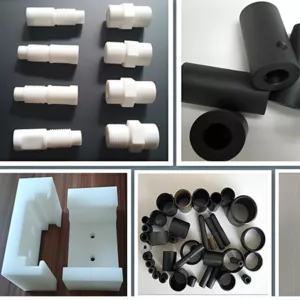
Chapter 2: CNC Machining Guidelines for HDPE
Core Principle: Chip evacuation is everything
With HDPE, you usually don’t “burn” the tool like metals. Instead, you get:
-
melted edges
-
gummy chips that re-weld
-
long stringers that wrap the tool
-
bad finish from heat + vibration
So the goal is simple: make thick chips and remove them immediately.
A nice rule Mekanika gives (it’s basic but true): make chips, not dust, because rubbing generates heat.
Tool Selection (what works in real shops)
Tool material: sharp carbide is standard.
Geometry: prioritize space for chips.
-
2-flute end mills are a common starting point (more room, less clogging).
-
Up-cut spirals help pull chips out (especially on routers).
-
Avoid high flute counts (3+), especially in deep slots, unless you have excellent air blast and rigid control.
Cutting Parameters: start points (but make them conditional)
Your earlier numbers (13k–18k rpm, 3000–4000 mm/min, 3–5 mm DOC) can be correct only under specific conditions (tool diameter, engagement, machine rigidity, workholding). The safer way is to publish a parameter table and clearly say: start here, then tune by chip shape.
Below are practical starting ranges that map to common shop setups.
Table 1 — Router vs VMC “Starting Points” (HDPE)
Assume sharp carbide, clean tool, strong chip evacuation. Tune using chip shape and edge temperature.
| Machine / Operation | Tool Dia | Flutes | RPM (start) | Feed (start) | Axial DOC (start) | Radial WOC (start) | Notes |
|---|---|---|---|---|---|---|---|
| CNC Router — profiling / contour | 6 mm | 2 | 14k–18k | 2500–4500 mm/min | 2–5 mm | 20–60% | Use air blast; keep chips flying |
| CNC Router — slotting | 6 mm | 1–2 | 14k–18k | 1800–3500 mm/min | 1–3 mm | 100% | Slotting traps heat; reduce DOC |
| CNC Router — pocket roughing (adaptive) | 6–10 mm | 2 | 12k–16k | 3000–6000 mm/min | 3–6 mm | 10–25% | Best for heat control |
| VMC — facing / roughing | 6–10 mm | 2 | 6k–12k | 800–2500 mm/min | 2–6 mm | 10–30% | More rigidity → more aggressive |
| VMC — drilling | 3–10 mm | 2 | 2k–6k | moderate | peck as needed | — | Clear chips; avoid melting in flute |
Chip-load logic (simple and transparent): Mekanika gives the standard relation:
Feed = RPM × flutes × chipload, and their chipload table includes soft plastics values up to roughly 0.10–0.14 mm/tooth for larger tools (depending on tool diameter and “starter vs advanced” tables).
Use that as the math backbone, then adjust by observation.
Workholding & Vibration (HDPE-specific pain)
HDPE is softer than metal. It can deform under clamps and “spring back” later.
-
Use wide contact clamps or soft jaws.
-
For sheet: vacuum table helps, but thin sheet can still “oil can” if tool forces are wrong.
-
Reduce chatter: keep tool stick-out short, and avoid tiny stepovers that rub.
Coolant & Heat Management
For HDPE, air blast is often the cleanest win: it cools + removes chips.
If you must use liquid coolant, avoid fluids that risk stress cracking or contamination concerns for food-contact parts (keep a plastics-clean workflow).
Shop cleanliness matters especially for food/medical trays: raw HDPE can be food-contact compliant in some grades, but post-processing contamination is the real risk.
Chapter 3: Design for Manufacturability (DFM) Tips
Tolerances (be honest + measure smart)
Many CNC services publish “standard tolerance” around ±0.005 in (±0.127 mm) as a general baseline (feature-dependent).
But HDPE is not aluminum. If the part sees temperature swings, the functional tolerance should be defined at a reference condition.
Metrology best practice: ISO GPS practice uses 20°C as the reference temperature for dimensional measurement.
So for tight fits, define inspection at (or corrected to) 20°C, and let the part stabilize before final measurement.
Feature design rules (practical, low-risk)
-
Add internal corner radii (end mills are round).
-
Avoid razor-thin walls in unsupported zones (HDPE can flex during cutting).
-
Keep holes away from edges when possible; HDPE is tough, but local stress can grow with temperature cycling.
Add a “Dimensional Control” Strategy (this is where HDPE projects fail)
This is the part many articles skip. In real orders, customers complain:
“It measured OK after machining, then tomorrow it’s off.”
Common reasons:
-
part is measured warm
-
internal stress releases after material removal
-
clamp pressure leaves dents or local bending
-
thin plates warp when one side is pocketed heavily
Process strategy (simple but effective):
-
Rough machine (leave stock on critical faces)
-
Rest / stabilize (time depends on thickness and stress)
-
Finish machine with light, symmetric passes
-
Inspect after stabilization at controlled temperature (target 20°C reference) boedeker.com
Pre-Machining Preparation: Annealing
For tighter parts, annealing is a good option to reduce warpage risk. One widely used guideline set (Boedeker) describes annealing plastics with controlled ramp/soak/cool practices to relieve stress. directplastics.co.uk
(Exact cycle depends on thickness and grade—don’t guess; use supplier data.)
If you want, Astrocnc.com can recommend a conservative anneal + machining plan based on your stock thickness and geometry.
Chapter 4: Post-Machining & Finishing
Deburring
Easy by hand. The goal is to remove “fuzz” without smearing edges.
Surface finish options
-
Machined finish is usually good enough for industrial use.
-
Sanding/polishing is possible, but HDPE tends to “smear” if you generate heat—use light pressure.
Joining & Assembly (HDPE reality: bonding is the hard mode)
My honest ranking for reliability:
-
Mechanical fastening (best overall)
-
Welding (strong, but needs skill + procedure control)
-
Adhesive bonding (possible, but conditions are strict)
Welding (recommended for tanks/structures)
Plastic welding methods for PE include hot-gas welding, extrusion welding, and heated-tool fusion processes, typically guided by standards/guidelines (e.g., DVS practices).
SIMONA’s welding documents discuss real workshop setup needs (nozzles, air handling, rework rules, seam design).
Adhesive bonding (when you must)
PE is low surface energy, so many adhesives struggle. There are specialty options:
-
3M describes DP8005 as designed to bond low surface energy plastics (polyolefins) with minimal prep, and provides technical positioning for that use case.
Surface treatment (flame/corona/plasma) is often used to increase surface activation and improve adhesion; plasma providers explain mechanisms like cleaning + introducing polar functional groups.
Chapter 5: Applications and Industry Examples
Industrial & Mechanical
-
Wear pads, guide rails, rollers, chemical handling parts
-
HDPE is popular where corrosion destroys metal parts
Marine & Outdoor
-
Dock bumpers, guards, outdoor signage
-
UV grades and black formulations are common outdoors
Food & Medical (non-implant, non-critical)
-
Food processing surfaces, trays, fixtures
-
Clean machining environment matters more than most people think
Consumer products
-
Prototypes, custom fixtures, replacement parts
If you need CNC-machined HDPE parts with controlled warpage and consistent inspection, that’s exactly the kind of project we support at Astrocnc.com.
Chapter 6: HDPE Machining vs. Other Manufacturing Methods
CNC Machining vs Injection Molding
-
Machining: best for low volume, fast iteration, high dimensional predictability
-
Molding: best for high volume, lower per-part cost after tooling
Tooling cost/lead time can be significant (project dependent).
CNC Machining vs 3D Printing
HDPE is not a friendly FDM material in typical desktop workflows. Real users note strong warping, shrinkage, and adhesion sensitivity when attempting HDPE printing.
So for “one strong part, quickly”, machining often wins on strength and reliability.
| Requirement | Best pick | Why |
|---|---|---|
| 1–200 pcs, strong, watertight, quick lead time | CNC machining | Stock material performance + fast turnaround |
| 10k+ pcs, simple geometry | Injection molding | Lowest cost per part after tooling Xometry |
| Prototype shape check only | 3D printing | Fast geometry, lower strength; HDPE is difficult in FDM Original Prusa 3D Printers |
| Chemical exposure + outdoor + corrosion concern | HDPE machining | Material resistance is the point |
Common HDPE Machining Problems (and fixes)
| Symptom | Likely cause | Fix |
|---|---|---|
| Melted edge / glossy smear | chips not clearing, rubbing | increase feed or reduce RPM; improve air blast |
| Long stringy “noodles” wrapping tool | too hot, slotting, poor evacuation | use 1–2 flutes; reduce DOC in slot; add air blast |
| Fuzzy burrs | tool not sharp, poor support | sharpen tool; support thin walls; adjust finishing pass |
| Part warps overnight | stress release, one-side heavy pocketing | rough–rest–finish; symmetrical removal; consider anneal |
| Clamp dents / assembly mismatch | clamp pressure too high | soft jaws, wider contact, lower clamp force |
| Hole size drifts | heat + elastic recovery | drill/ream strategy, stabilize temperature, measure at reference |
Real Company Case Studies (web-verifiable)
Case 1 — Blue Robotics (ROV thruster guard component)
-
Company / product: Blue Robotics — BlueROV2 Heavy Thruster Guards
-
Use: protects ROV thrusters; prevents snagging (tether/weeds/ropes)
-
Material: HDPE thruster guard (explicitly stated)
-
Evidence of engineering data: page includes 2D drawings + downloadable 3D models (CAD package link)
-
Notes (practical machining read): parts like these are typically cut from HDPE sheet on CNC routers; the key is clean edges and controlled fit around brackets (this is an inference, not stated on the page).
Case 2 — West River Conveyors (corrosive salt mining environment)
-
Company / scenario: West River Conveyors — underground conveyor conveying salt in Louisiana
-
Problem: steel rollers corroded heavily; frequent maintenance
-
Solution: switch to HDPE conveyor rollers for corrosion resistance
-
Outcome (quant): the page emphasizes reduced corrosion/maintenance needs; exact % savings not published on the visible section.
Case 3 — Röchling Industrial (material utilization + large-part manufacturing)
-
Company / product: Röchling Polystone® MegaSheet™ (HDPE sheet up to 8 ft × 20 ft)
-
Key claim: “up to an incredible 40% yield advantage” vs standard sheet sizes (example nesting shown)
-
Why it matters for machining: better nesting = less scrap + fewer weld seams for big parts (their brochure highlights large flanges/manholes and reduced seam concerns).
Conclusion: Why Machine HDPE?
If you need robust, chemically resistant, water-friendly custom parts—HDPE machining is one of the most cost-effective routes before you jump into molds. The technical keys are not complicated, but they must be respected:
-
control heat by chip thickness and chip removal
-
prevent “tomorrow-size drift” with stabilized measurement and smart process planning
-
choose joining methods realistically (fasteners/welding first; adhesives only with proper systems)
If you want a plastics-specific machining plan (feeds/speeds logic + warpage control + inspection plan), you can send your drawing to Astrocnc.com.
FAQ
Can you tap threads in HDPE?
Yes. It machines easily. In practice, coarse threads and adequate engagement length are more reliable than fine threads (HDPE can creep under load).
Does HDPE warp after machining?
It can. Warpage risk increases with thin plates, heavy one-side pocketing, and high internal stress. Use rough-rest-finish and consider annealing guidance from established plastics suppliers.
What are the main color options?
Most industrial stock is black or white, with other colors available depending on supplier and grade.
Is machined HDPE food-safe?
Many HDPE grades are used for food contact, but the final result depends on material certification and shop cleanliness (cross-contamination is the real risk).
Leave A Comment