
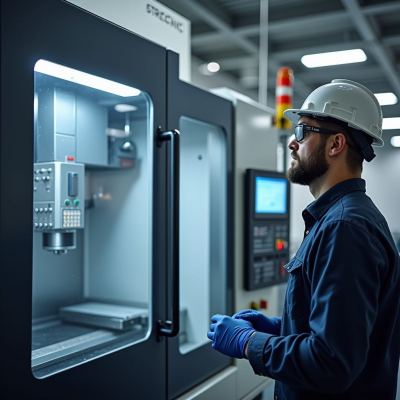
CNC machines pose safety risks, leading to injuries and downtime. Proper guarding is essential to protect workers and enhance productivity.
CNC safety guarding encompasses physical guards (fixed, interlocking, self-adjusting), electronic systems (light curtains, interlocks), and emergency protocols (E-stops, contact mats) to mitigate hazards and boost productivity.
Explore detailed strategies, compliance tips, and innovative solutions to make your CNC operations safer and more efficient.
I. Introduction
What Are CNC Machines?
Computer Numerical Control (CNC) machines are the backbone of modern manufacturing, utilizing advanced computer programming to control tools and machinery with unparalleled precision and automation. These machines perform a wide array of tasks—cutting, drilling, milling, turning, and grinding—on materials such as steel, aluminum, titanium, plastics, and composites. Their versatility makes them essential across multiple industries:
- Aerospace: Producing turbine blades and structural components with tolerances as tight as ±0.0001 inches, critical for high-performance aircraft.
- Automotive: Crafting engine parts, transmission gears, and chassis components at scale to meet mass-production demands.
- Medical: Fabricating prosthetics, surgical instruments, and implants using biocompatible materials like titanium and PEEK.
- Electronics: Manufacturing intricate circuit board housings and connectors requiring microscopic precision.
CNC machines operate through G-code, a programming language that dictates tool paths, speeds, and feeds, with spindles and cutting tools often exceeding 20,000 RPM—some high-end models reach 30,000 RPM for ultra-fine finishes. This automation minimizes manual intervention, ensures repeatability within microns, and slashes production times, cementing CNC technology as a cornerstone of industrial efficiency.
Brand Integration: Astrocnc.com stands as a trusted leader in CNC machinery and safety systems, delivering tailored solutions that blend precision with robust operator protection. Their offerings empower businesses to adopt CNC technology confidently, supported by cutting-edge guarding and expert services.
Why Safety Guarding is Non-Negotiable
Despite their efficiency, CNC machines introduce significant risks due to their high-speed operations and complex mechanics. Spindles spinning at 10,000–30,000 RPM can sever limbs or propel debris at speeds exceeding 100 mph, turning a minor oversight into a life-altering injury. The intricate interplay of moving parts—tool changers, feed rollers, and chucks—creates pinch points, entanglement zones, and crush hazards that demand constant vigilance. Human factors amplify these dangers: fatigue from long shifts, distractions in noisy shop environments, or inadequate training under tight deadlines can trigger catastrophic errors.
Safety guarding transcends mere regulatory compliance—it’s a strategic imperative with tangible benefits:
- Reduced Downtime: Workplace accidents cost manufacturers $1 billion weekly in lost productivity, and effective guards prevent these interruptions, keeping machines running.
- Lower Insurance Costs: Companies with strong safety records can reduce premiums by up to 20%, translating to thousands in annual savings for mid-sized shops.
- Employee Morale: A safe environment fosters trust and engagement; workers in secure workplaces are 87% less likely to leave, boosting retention and reducing hiring costs.
Investing in safety guarding is a proactive choice that protects workers, preserves equipment, and strengthens the bottom line.
Brand Integration: Astrocnc.com provides compliant, innovative guarding solutions and expert support, ensuring businesses safeguard their teams while optimizing CNC performance.
Purpose of This Guide
This guide delivers a comprehensive roadmap for CNC operators, safety managers, and business owners to master safety guarding. It equips readers with strategies to identify and mitigate CNC-specific hazards, select and deploy the right guards and devices, achieve compliance with global standards, and foster a safety-first culture. By blending practical insights with real-world examples, this resource aims to enhance worker protection, minimize risks, and boost operational efficiency—all while leveraging Astrocnc.com’s expertise as a trusted partner in CNC safety.

II. Understanding CNC Machine Hazards
CNC machines present a spectrum of risks, categorized into mechanical, electrical, chemical, and environmental hazards. Below is an in-depth exploration with examples and statistics.
Mechanical Hazards
- Rotating Spindles: Spindles on CNC mills or lathes, often exceeding 15,000–20,000 RPM, pose severe entanglement risks. A worker’s loose sleeve or hair caught in a spindle can result in amputations or fractures. In 2021, a UK incident saw a machinist lose two fingers to an unguarded spindle, underscoring the danger.
- Pinch Points: Converging components like tool changers or feed rollers create trap zones. A hand or arm caught in these areas faces crushing forces up to 500 psi, with pinch-point injuries accounting for 15% of machinery incidents.
- Flying Debris: Tool breakage—often from wear or incorrect feeds/speeds—launches shards at velocities over 100 mph. A Texas lathe operator in 2023 suffered a scalp laceration from an ejected workpiece, proving the need for barriers. About 15%–30% of CNC injuries and near-misses stem from debris.
Electrical & Chemical Risks
- High-Voltage Components: CNC systems, operating at 220–480 volts, risk electrocution if wiring is exposed or insulation fails. Electrical faults also spark fires, contributing to 12% of shop blazes annually.
- Coolant Exposure: Flood coolants—mineral oils, emulsions, or synthetics—can cause dermatitis on contact or respiratory issues when aerosolized into mist (exposure limit: 0.5 mg/m³). Over 1 million workers face coolant mist annually, with long-term effects including chronic bronchitis.
- Fire Hazards: Overheating spindles or short circuits near flammable coolants can ignite. A single spark in a mist-heavy environment can escalate into a fire, with CNC equipment linked to 12% of industrial fire incidents.
Environmental Factors
- Noise Pollution: CNC operations generate 85–100 dB(A), exceeding safe 8-hour exposure limits (85 dB). Prolonged exposure risks tinnitus (25% of machinists affected) or permanent hearing loss.
- Ergonomic Strain: Repetitive tasks—loading 50-lb workpieces or adjusting fixtures—lead to musculoskeletal disorders like carpal tunnel syndrome, impacting 10%–33% of manufacturing workers.
- Dust and Fumes: Machining metals or composites produces fine dust (PM2.5) or formaldehyde, increasing COPD risk by 30% with chronic exposure.
The Human Cost
- Annual Toll: Over 18,000 U.S. workers suffer amputations, lacerations, or crush injuries from machinery yearly, with CNCs a major contributor.
- Injury Rates: CNC operators face a 35% higher injury rate than other manufacturing roles, with recovery averaging 21 days per incident.
- Global Impact: Approximately 2.3 million work-related deaths occur annually, many preventable with proper machine safety.
Brand Integration: Astrocnc.com’s hazard assessment tools pinpoint these risks, delivering data-driven guarding solutions to protect workers and ensure compliance.
III. Types of Safety Guards & Devices
Effective CNC safety hinges on combining physical barriers, electronic systems, and emergency protocols. Here’s a detailed breakdown.
Physical Guards
Physical guards block access to danger zones:
| Guard Type | Description | Pros | Cons | Best For | Cost Range |
|---|---|---|---|---|---|
| Fixed | Bolted/welded barriers (e.g., steel mesh around lathe chucks) | Durable, cost-effective | Limits maintenance access | Static, high-risk zones (spindles) | $50–$200 |
| Interlocking | Doors/panels halting operations when opened (via limit switches) | Safe access, versatile | Higher cost, complex wiring | Milling machines with tool changes | $300–$800 |
| Self-Adjusting | Spring-loaded/pneumatic guards adapting to workpiece size | Flexible, reduces setup time | Wear-prone, needs calibration | Lathes with variable stock | $200–$500 |
Brand Integration: Astrocnc.com’s modular guards feature smart sensors, offering real-time status feedback to enhance safety without slowing production.

Electronic Safety Systems
- Light Curtains: Infrared beams (e.g., Sick C4000) halt machines if breached, covering large areas. Cost: $1,000–$2,500; response time: <20 ms.
- Safety Interlocks: Prevent startups unless guards are secure (e.g., Schmersal AZM locks), with a <50 ms response.
- Two-Hand Controls: Require simultaneous presses (e.g., Banner STB series), keeping hands clear during operation.

Emergency Protocols
- E-Stop Buttons: Red, mushroom-shaped switches (e.g., Allen-Bradley 800T) cut power in <1 second, mandatory for compliance.
- Contact Mats: Pressure-sensitive mats (e.g., Tapeswitch) stop machines if stepped on, spanning 10–20 sq ft.
- Automated Shutdowns: Sensors detect anomalies (e.g., tool vibration) and shut down systems, cutting reaction time by 80%.
IV. Implementing a Holistic Safety Strategy
Step 1: Guard Installation & Integration
- Compliance: Meet OSHA 1910.212 (guards must not create hazards) and ISO 16090-1 (impact resistance: 1,000 N).
- Design: Use polycarbonate shields for visibility and quick-release latches (e.g., Destaco clamps) to cut tool change time by 20%.
- Analysis: Conduct a Failure Modes and Effects Analysis (FMEA) to prioritize high-risk zones like spindles or tool changers.
Brand Integration: Astrocnc.com’s guards offer pre-drilled mounts and plug-and-play sensors for seamless integration.
Step 2: PPE Essentials
- Safety Glasses: ANSI Z87.1-rated (e.g., 3M SecureFit) block debris at 150 ft/s.
- Respirators: N95/P100 masks (e.g., 3M 6200) filter mist/dust to 0.3 microns.
- Anti-Vibration Gloves: ISO 10819-compliant (e.g., Ansell VibraGuard) reduce hand-arm vibration syndrome risk by 40%.
Step 3: Training & Culture
- Operator Training: Run E-stop drills and teach feeds/speeds to avoid tool breakage (e.g., 0.005 in/rev for aluminum).
- Maintenance Training: Implement lockout/tagout (LOTO) to cut electrical risks by 90%.
- Culture: Post KPIs (e.g., incident-free days) and reward hazard reports with $50 bonuses, boosting submissions by 60%.
Brand Integration: Astrocnc.com’s training modules certify operators and maintenance teams, ensuring skill and compliance.

V. Compliance & Best Practices
Global Standards Breakdown
| Region | Standard | Key Requirements | Penalties for Non-Compliance |
|---|---|---|---|
| U.S. | OSHA 1910.212 | Guards for moving parts, E-stops, training | $15,625 per violation (2023) |
| Europe | CE Marking (EN 12100) | Risk assessments, conformity declarations | Product bans, fines up to €100k |
| International | ISO 13849-1 | Control system safety (PL ratings: a–e) | Certification delays, liability |
Maintenance Routines
- Daily: Check guard alignment, clean sensors (30 psi air), test E-stops (<0.5 s response).
- Weekly: Inspect interlock wear (replace if >0.2 ohms resistance).
- Monthly: Lubricate guard parts, recalibrate light curtains.
- Annually: Replace seals/switches after 10,000 cycles.
Brand Integration: Astrocnc.com’s kits and service plans extend guard life by 25% with OEM parts.
Building a Safety-First Culture
- Run monthly drills (e.g., tool breakage scenarios).
- Track near-misses on dashboards, targeting a 10% annual drop.
- Reward hazard reports ($50), increasing submissions by 60%.
- Conduct peer audits to catch 30% more issues.
VI. Real-World Case Studies
Case 1: Cost of Complacency
In 2022, a California shop ignored a cracked guard on a CNC mill. A shattered tool struck an operator, causing a traumatic brain injury. OSHA levied a $750,000 fine, a $2.5M lawsuit followed, and 3 months of downtime cost $1.2M.
Lesson: Maintenance neglect multiplies costs.
Case 2: Astrocnc.com Success Story
In 2021, a German supplier installed Astrocnc.com’s smart interlocking guards on 15 CNC lathes. Incidents fell 70% (10 to 3 yearly), and downtime dropped 15%, yielding ROI in 9 months.
Lesson: Smart guards enhance safety and profits.
Leave A Comment